
Updated July 2026
Dealers ask us every week what actually works for car dealership SEO in 2026. After 700+ dealer websites, here is the short answer: an optimized Google Business Profile, real content on every page of your site, local pages built around the body styles you stock, reviews coming in every week, and a name people around town recognize.
This guide covers all of it, with real numbers from real Carolina dealers. No theory, no filler. Start at the top or jump to the section you need.
Where Your Traffic Actually Comes From (It Is Not What You Think)
Across the dealer sites I review in Google Search Console, 80 to 90% of clicks come from branded search. Someone types the dealership's name. If you are Queen City Automotive, 80-90% of the people landing on your site searched "Queen City," "Queen City Autos," or the full name. Only 10-20% arrived from searches like "used cars near me," "bad credit financing," or "used car dealerships."
Those branded searchers already know you exist. They drove past the lot, or saw your car on CarGurus or Facebook Marketplace. They are on your website for one reason: to decide whether to trust you.
The on-page job is not ranking. It is selling the dealership to someone already standing at the door.
Here is what that visitor wants to know:
- Who you are
- Why they should buy from you
- Why they should trust you
- How long you have been in business
- That you have other happy customers
- What kind of vehicles you focus on
- Whether you have a service department
- Whether you take trade-ins
- How local you are
They are not primarily there to browse vehicles. But when they do land on a vehicle, the trust content has to be baked into that page too, or they leave without calling. Almost everyone in this industry gets this backwards, and it changes what every page on your site is for.
Car Dealer SEO Best Practices
Here is the rundown: seventeen sections, numbered so you can jump straight to what you need. Every numbered marker down the page matches this list, and each section ends with a link back here.
- Local SEO: Google Business Profile, citations, and location pages
- The pages that are not vehicle pages
- Body style pages beat make and model pages
- Blog posts vs. local pages
- Stop writing like a robot
- Dealerships with a service department
- Link building: sponsor local things
- Add personality with video
- Use Instagram and social media
- Be part of local online conversations
- Make your website MORE mobile-friendly
- Show up in ChatGPT and Google AI Mode
- How long does dealership SEO take?
- What should car dealership SEO cost?
- How to tell if an SEO vendor is worth paying
- What this looks like with real numbers
- The pattern across ten dealers
- Most asked car dealer SEO questions
Local SEO for Car Dealerships: Google Business Profile, Citations, and Location Pages
Local SEO matters more for car dealers than almost any other business. People are not buying cars from across the country. They are searching "used cars near me" and "trucks for 20k in Winston-Salem," and Google answers with the local pack before anything else.
How do I improve local SEO for a car dealership?
Fill out every field on your Google Business Profile, pick the right categories, get listed on the major citation sites, post to the profile regularly, and collect reviews every week. For a local dealer, the profile does as much work as the website.
Start with the profile itself. Fill out every field:
- Your hours. Update them often and add holiday hours.
- Your categories. Max them out, starting with the list below.
- Pictures, added regularly. Take them on your phone from your lot. The geolocation data on the images helps.
- Regular posts about your business. Google favors an active profile.
Which Google Business Profile categories should a used car dealer choose?
Set Used Car Dealer as your primary category. Then add Car Dealer, Used Truck Dealer, Truck Dealer, Motor Vehicle Dealer, Auto Market, and Car Finance and Loan Company.
- Used Car Dealer (primary)
- Car Dealer
- Used Truck Dealer
- Truck Dealer
- Motor Vehicle Dealer
- Auto Market
- Car Finance and Loan Company
Which citations and directories matter for a car dealer?
Start with Google, Bing, Apple Maps, Yelp, Nextdoor, Facebook, Instagram, X, YouTube, TikTok, DealerRater, and your local Chamber of Commerce. There is no waste of time on the major platforms. This is the starter packet, and the minimum.
Same name, same address, same phone number on every one of them. Matching listings tell Google you are a real, established local business, and each one is another place a buyer or an AI answer can find you.
What should you post on a Google Business Profile?
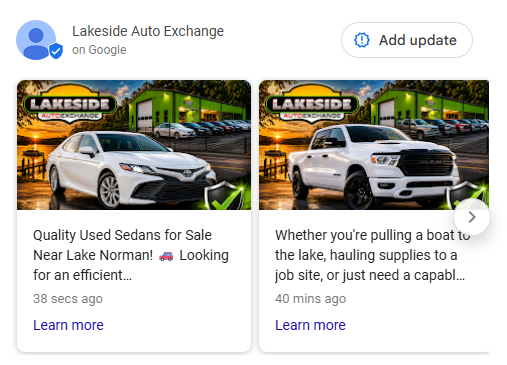
We run 4 to 6 posts a month for dealers on a repeating rotation:
- Body styles currently for sale
- Holiday shout-outs
- Customer reviews
- A call to action for each service the dealer offers
Then repeat the cycle. It does not need to be clever. It needs to be consistent.
Get more reviews, and answer every one
Reviews are half the local ranking game, and almost no dealer has a real system for getting them. Respond to every review, including the negative ones. How you handle criticism tells the next buyer more than the review itself.
The best system we run is the QR review sheet. Dealers print the full deal pack for the customer. Everyone signs, the customer gets copies, and the dealer walks through each form and why it is being signed. The last page in the stack is a QR code printout asking for a review.
It doubles as the moment you walk the customer out to their new vehicle and take their photo. They scan the code right there, attach the photo, and leave the review while they are still excited. A review with a real face and a real car is worth ten anonymous ones. This sheet is part of the reputation kit in every KGI SEO tier.
Can a dealership outside the city rank for that city?
Sometimes, and you should know the ceiling before you spend. We built out buy here pay here raleigh for a client just outside the city and reached position 3. We could not pass the top two spots, because both of those dealerships were physically located in Raleigh. Proximity is a heavy local ranking factor.
That ceiling is not necessarily permanent. Over a long period you could build a real content silo around BHPH Raleigh and likely get there. It just was not necessary for that client.
The bigger point: telling you what is and is not possible before you spend is the whole job. No false promises.
What can an independent dealer realistically rank for?
Bigger stores have bigger budgets, more vehicles, and a bigger brand, and brand is the most important of the three. But it is not impossible. It comes down to ranking factors: number of reviews (a major one), optimized pages, an optimized Google Business Profile, and number of backlinks.
It can be won with work. The sections below are the work.
Back to the table of contents ↑
What to Put on the Pages That Are Not Vehicle Pages
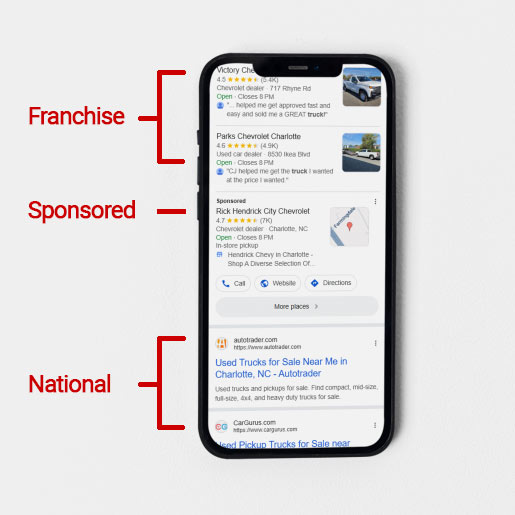
When I audit a dealer website, the problem is usually not that something is broken. It is that nothing on the site is optimized for anything beyond a literal vehicle for sale. The template optimizes for "Used 2015 Toyota Camry in Charlotte," and CarGurus, Carfax, Cars.com, Autotrader, and CarMax are all more optimized for that exact phrase. You lose that fight before it starts.
Everything else on the site is left empty. That is the opportunity.
The rule behind everything in this section: treat every page like a landing page. Some of the sections will repeat from page to page, and that is fine, because you never know which page a visitor enters from. Give them the same trust signals no matter where they land.
The finance page
The clearest example. On most dealer template sites, the finance page is an embedded credit application and nothing else. No explanation of the process, no reason to finance with this dealer, nothing. The page is basically asking for a Social Security number on the first date.
A real finance page has:
- What financing you actually offer
- A plain step-by-step of how the process works
- Finance-specific customer reviews, the ones that mention easy financing or a smooth loan process
- A call to action to complete the application
You will never get SEO from a page you have no content on. And that is what standard dealer template finance pages look like across the country.
The homepage
The homepage is the concierge. It is the beginning of the buyer's connection to your dealership, and its only job is moving them through the funnel:
- Tell them who you are and what you do
- Vehicles up top: some inventory and the newly added units
- A section about the dealership itself
- Your services, with links out to each page. For most dealers that is sell your vehicle, request a vehicle, and finance a vehicle
- Testimonials
- A map pack tied to your Google Business Profile, for trust and as a signal to Google
- A call to action at the bottom, so a visitor who scrolls to the end has a next step without scrolling back up
The About page
The About page is where the trust story gets room to breathe:
- The story of the dealer
- The dealership itself
- Who your customers are
- Who you market to and who you sell to
- The area you are in
This is also where the staff gets listed, where a reviews section lives, and where you link out to inventory, because a visitor who just decided they trust you needs somewhere to go next.
One more move for secondary pages like finance and request-a-vehicle: load a live inventory widget on them, like a featured vehicles row, with a little text along the lines of "check out the inventory before you send your request, you might find something you like." Every page can sell a car, not just the pages built to.
Back to the table of contents ↑
Body Style Pages Beat Make and Model Pages
Build body style pages. With used inventory you might have a specific make and model for seven days, and then it is gone. A body style page is more generic, you will have more of it in inventory, and it matches how people search when they want a truck or a minivan but have not settled on a make.
Put another way: a Honda Odyssey page is a thin page. A minivan page is not. Body style pages exist to keep your site from having thin pages. Ranking for a vehicle that sells in a week does not help you. Ranking for the body style you always stock does.
What goes on the page:
- The vehicle type discussed in relation to your local area
- Local search signals and landmarks in the content
- Most importantly: those vehicles, for sale, on the page
And what not to build: pages for body styles you do not sell. A dealer in the NC mountains selling trucks and SUVs does not get a convertibles page. They get truck and SUV pages.
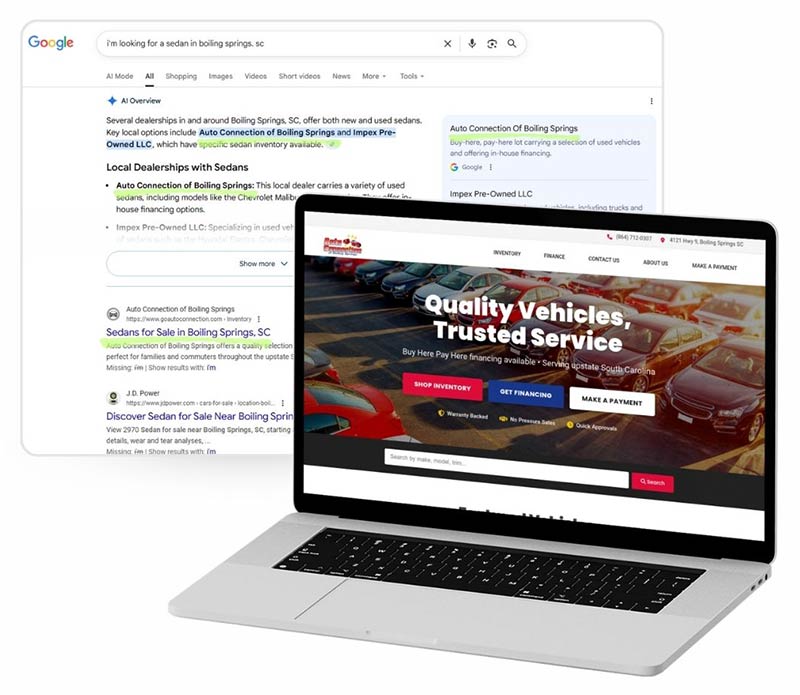
Real local pages we have built and ranked: "sedans for sale boiling springs sc," "auto repair denver nc," and "buy here pay here raleigh" (position 3, with the proximity ceiling covered above). How long does it take? Not as long as you would think, because so few dealers do it. When you put actual effort in, you can rank.
Here is how search intent maps to the page that should own it:
| Search intent | Page that should own it |
|---|---|
| Used car dealership + city | Homepage or primary local page |
| Used cars for sale + city | Inventory landing page |
| Buy here pay here + city | Dedicated BHPH page |
| Auto repair + city | Service landing page |
| Year/make/model for sale | Vehicle detail page |
| Trucks or SUVs under a price | Filtered inventory page |
Back to the table of contents ↑
Blog Posts vs. Local Pages
These are two different tools. A blog is typically top-of-funnel content like "what is a doc fee" or "do used cars depreciate." A local body style page is specific, targeted, local SEO content built to rank in your town and show your inventory. When a vendor pitches blog articles as the whole strategy, they are selling you the first tool for the second job.
Back to the table of contents ↑
Stop Writing Like a Robot, Start Writing Like You Know Cars
Gone are the days of keyword stuffing. You know the descriptions I mean: "This red Ford F-150 truck is a great red Ford F-150 truck for anyone looking for a red Ford F-150 truck."
Search and AI favor content that actually knows what it is talking about. That means:
Write like the car expert you are. When you describe a 2022 Honda Civic, do not just list features. Explain why someone would want them. "The CVT transmission in this Civic gets an EPA-estimated 32 city/42 highway mpg, which means fewer gas station stops for your commute."
Include real numbers and sources. Instead of "great gas mileage," say "35 mpg combined according to EPA testing." Specifics win.
Answer the questions your customers actually ask. Your sales team hears the same questions every day. Turn those into content: trim level differences, how your warranty options work, why finance through the dealership versus a bank.
Back to the table of contents ↑
Dealerships With a Service Department Need a Second Setup
Usually, yes. Google picks which side of your business to trust based on your Google Business Profile's primary category, so a dealership with a service department should run two profiles: one for sales and one for repair, each linking to the page that matches its category.
Here is what that looks like in real data. One of our Gaffney, SC dealers ranks at position 2.3 for "mechanics gaffney sc" and 5.6 for "car repair gaffney sc," but 15.4 for "used cars gaffney sc" and 34.8 for "car dealerships gaffney sc." Google trusts the repair business more than the sales business, and the profile's primary category is what decides which one Google surfaces.
The fix is two Google Business Profiles. Either two profiles and two websites, or two profiles where the repair profile points directly at the service page instead of the dealership homepage. The profile should link to the page that matches its category, not to the homepage by default.
Back to the table of contents ↑
Link Building for Car Dealerships: Sponsor Local Things
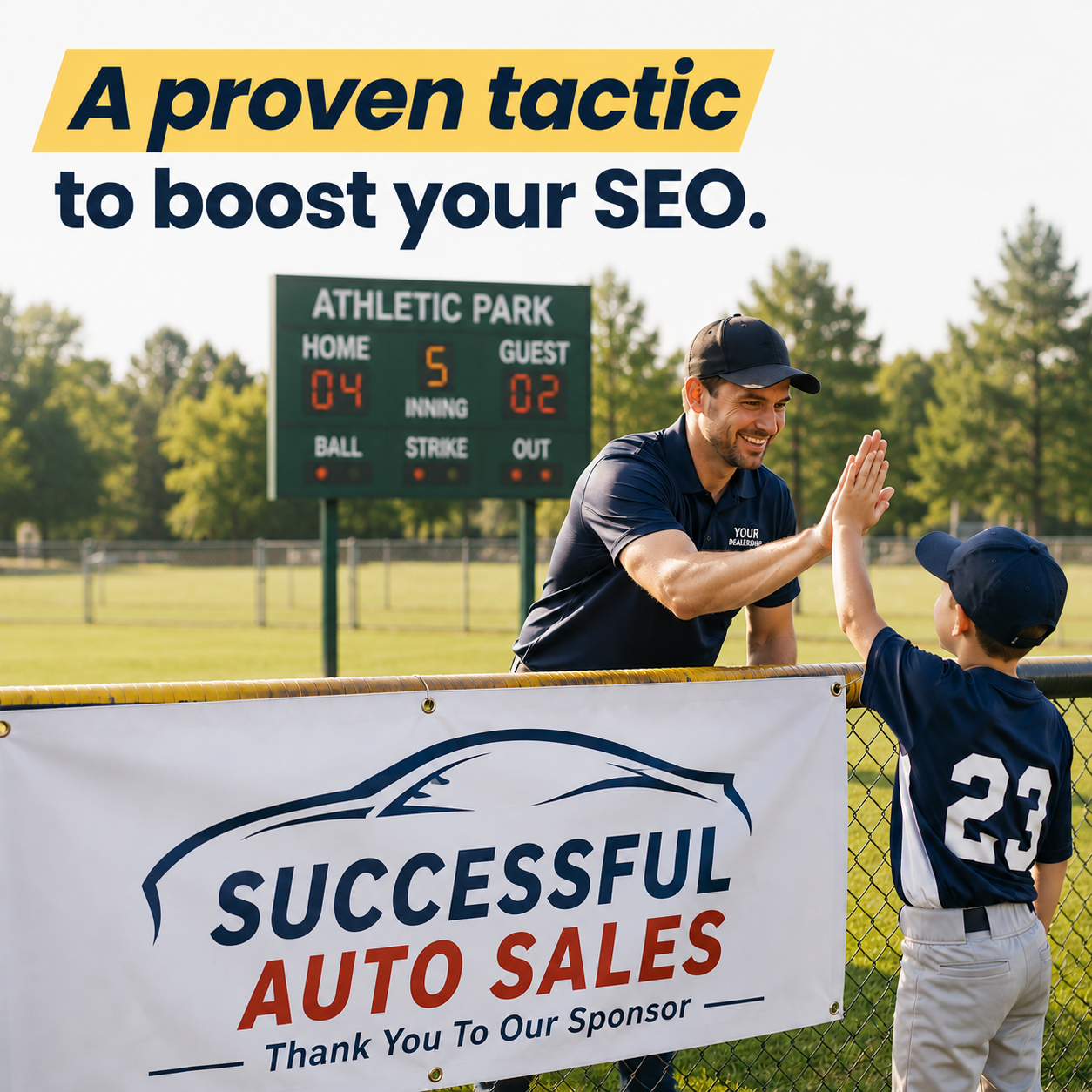
Set a budget for supporting local schools, PTAs, the Chamber of Commerce, charity drives, and youth sports. Not just because it is good for the community (though it is), but because it gets your dealership mentioned and linked from legitimate local websites. Those are backlinks. It is win-win: these organizations need your funding, and you need their link juice.
Authentic local backlinks tell Google and AI that you are a trusted part of the community. They are worth far more than generic directory links. Consider it part of your advertising budget, and start with the easiest one: your local Chamber of Commerce membership.
Look for sponsorships that list "link and logo" as a benefit. Those are the ones that help your SEO. At our Own The Market tier, sponsorship and backlink research is done for you.
Back to the table of contents ↑
Add Some Personality with Video Content
Video is where you stand out. AI understands video content now, which means your walk-arounds and customer testimonials help you get found.
Easy video ideas that work:
- Walk-around tours of what is new on the lot
- "Meet the team" videos. People buy from people they know.
- Customer testimonials: a quick 15-second clip, or B-roll with a new review overlaid
- Answer the questions buyers ask every week
- Have fun. See how many makes each team member can name in 20 seconds.
You do not need a production crew. A phone video with personality beats a stock photo every time. Post them everywhere, especially YouTube Shorts, and put the FAQ and tour videos on your Google Business Profile too.
Back to the table of contents ↑
Use Instagram and Social Media Strategically
Google indexes Instagram posts, which means your social content can show up in search results. Post the videos above, and add carousel posts: swipeable images made in something like Canva with information about the services you offer. Use local hashtags and geotag your location consistently.
See the trend yet? We are trying to show up EVERYWHERE.
Back to the table of contents ↑
Be Part of Local Online Conversations
This is where most dealers miss the boat entirely. AI pulls information from everywhere: Reddit, Quora, local Facebook groups, community forums.
Join local Facebook groups and answer car-buying questions without being salesy. Answer questions in your city's subreddit when people ask about dealers. Get mentioned in local news by hosting events or charity drives. Every one of those mentions is a source an AI answer can cite.
Back to the table of contents ↑
Make Your Website MORE Mobile-Friendly
The worst mobile offender I see on dealer sites is not slow load times. It is poorly built pages with extremely large headers, where every page requires a scroll before the visitor sees anything. There is effectively no above-the-fold content. A buyer lands, sees a giant logo and a menu, and has to work just to find out what the page is about.
Most dealership traffic is mobile, so run this check on your own phone right now. Can you easily:
- See real content on each page before you scroll?
- Browse your inventory?
- View high-quality photos?
- Tap to call or get directions?
- Submit a lead form without wanting to throw your phone?
If any of that was frustrating, your customers feel the same way, and they leave.
Back to the table of contents ↑
How to Show Up in ChatGPT and Google AI Mode
The internet is transitioning to a zero-click world. People get answers directly from AI without visiting websites, and Google's AI Mode is becoming the default search experience. If you are not part of that conversation, you are invisible.
When someone asks AI for the "best used car dealership near me," the answer is pulled from your Google Business Profile, your reviews across multiple platforms, mentions of your dealership in local forums, your YouTube videos, and your Instagram posts. Everything in this guide feeds that machine.
The tactical version: post daily videos on social media saying "Bob here, your #1 local used car dealer in TOWN" until everyone knows it. Get an optimized dealership website. Get more reviews on Google. Donate your time and talent at local nonprofits with car-related service or a giveaway. Get after it, Bob.
One more source most dealers never touch: press releases. At our top tier we run one a month through a PR publisher, distributed across news and web outlets for pickup. They are strong trust signals, and AI does tend to use them as a source.
Back to the table of contents ↑
How Long Does Dealership SEO Take?
Think in phases, not one timeline. Phase one is the website: two to four weeks to a fully custom site with real content on every page. Phase two is the Google Business Profile: one to two weeks for a clean optimization. Phase three is results: in the Lakeside case, real movement showed up three to six months in.
Why the website comes first: the website is the anchor. It is the only thing you own in your SEO. Google can take your Business Profile away tomorrow. So the website comes first.
If you only need the profile work, a standalone Google Business Profile cleanup runs $300 to $750 depending on the dealership and how many citation sites are involved.
And phase three is where patience pays. In the Lakeside rebuild, the numbers below showed up three to six months in, and we were shocked by what we were seeing.
Back to the table of contents ↑
What Should Car Dealership SEO Cost?
For an independent lot, real automotive SEO runs $150 to $2,500 a month depending on how fast you want to move, plus the $149 a month website it runs on. Franchise stores pay far more. The OEM-certified platforms they run on start around $1,500 a month for the website alone, and the packages with real SEO in them start around $3,000.
There are two markets for automotive SEO. Franchise and national stores buy from OEM-certified vendors like Dealer.com and DealerOn, and on those platforms the required website alone costs roughly ten times what ours does, before the SEO package even starts. Independent lots are not that buyer and should not be priced like one. All in, that is the difference between about $300 a month and $3,000 and up.
You do not need a franchise budget to rank like a franchise store.
Here is our published pricing:
| Tier | Price | What it is |
|---|---|---|
| Content Engine | $150/mo | 1 custom local buyer page a month, ongoing GBP optimization, reputation kit for Google reviews, performance snapshot once a year |
| Own Your Town | $750/mo | 1 local buyer page a month, 4-6 GBP posts a month, GBP maintained, citations built and synced, review generation system installed, 1 comparison page a quarter, 6 holiday banners a year, snapshot twice a year |
| Own The Market | $2,500/mo | Everything in Own Your Town plus 2 local pages a month, 1 comparison page a month, custom SRP and VDP design, 1 press release a month, sponsorship and backlink research, an on-site day once a year for real lot photos and video, quarterly deep-dive with a geogrid ranking map, and my direct number |
Own The Market is one dealer per market. The website platform is $149/mo billed separately, with a $250 setup fee. Own Your Town plus the website is $899/mo all in. Own The Market includes the website and waives the setup fee. We are month to month; larger marketing agencies typically require a term commitment.
Full detail on every tier is on the Automotive SEO page, and we published a line-by-line breakdown of the entry tier in What Does $150/mo of SEO for Car Dealers Get You?
Back to the table of contents ↑
How to Tell if a Dealership SEO Vendor Is Worth Paying
Four red flags, from someone who has cleaned up after all of them.
They lead with ranking your vehicles
For an independent lot this is the wrong target. You might have one of that make and model. When it sells, the page and everything you invested in it goes away. Body style is the better target: more generic, more inventory behind it, and it matches how people actually shop when they want a truck or a minivan but have not settled on a make.
They want to put you on WordPress
Dealers do not log into WordPress and maintain it themselves. The site gets built, and then there is no ongoing package paying anyone to manage it. Updates get missed, or updates land and break plugins, and there is a long record of security breaches through plugins. A fast HTML site improves both the quality and the volume of content you can produce. We practice what we preach here: we moved our own site off WordPress to a Claude Code-run HTML site.
They pitch blog articles as the strategy
A blog is top-of-funnel. A local body style page is targeted local SEO. If a vendor cannot explain the difference, they are selling the cheap one.
They promise a #1 ranking
Anyone can promise a #1 ranking. Nobody controls Google, so nobody can guarantee one. A real vendor promises the work, the communication, and an honest report on what happened.
And one thing to demand: own your domain
This industry has a habit of skipping the setup step. Dealers frequently do not know where their domain is registered or who owns it, and that is how domains expire out from under them. Our approach: you buy the domain through GoDaddy in your own name and give your developer delegate access. Ownership stays with you, not the vendor.
Back to the table of contents ↑
What This Looks Like With Real Numbers
Lakeside Auto Exchange in Denver, NC. We rebuilt the site in February 2026. Here is the before and after from Google Search Console:
| Metric | Previous 6 months | Latest 6 months |
|---|---|---|
| Total clicks | 214 | 899 |
| Impressions | 21.6K | 18.5K |
| CTR | 1% | 4.9% |
| Average position | 35.3 | 18.2 |
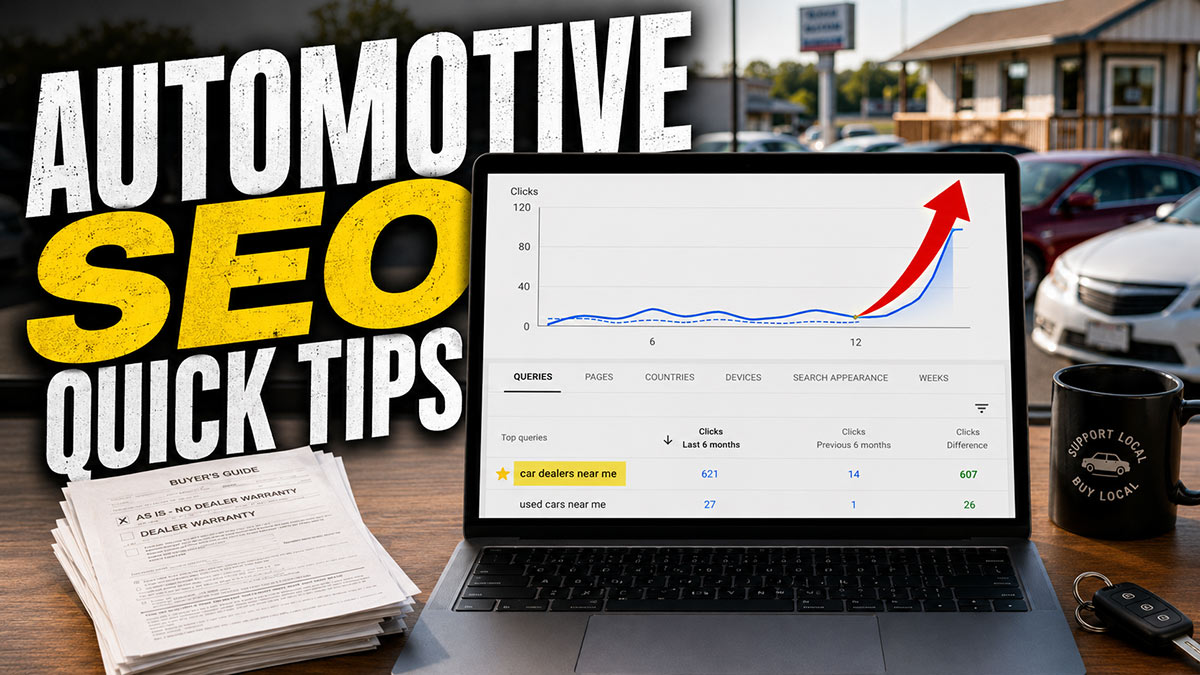
Google Business Profile clicks to the website went from 88 in the three months before to 551 in the three months after. The query "used cars near me" went from 1 click in six months to 27.
The detail worth sitting with: impressions went down 14% while clicks went up 320%. Google showed the site to fewer people, and more of them clicked. That is what relevance looks like in the data.
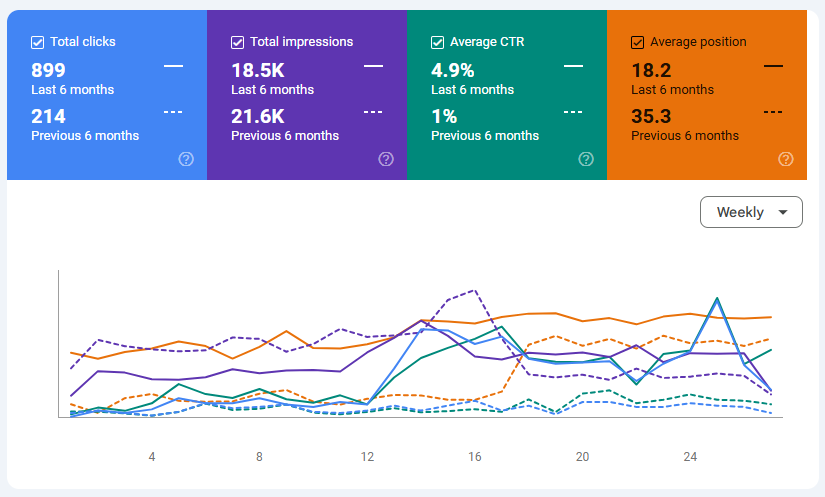
One dealer, one market, six months. We are not calling it typical, and the full case study shows exactly what we did and the raw screenshots.
Back to the table of contents ↑
The Pattern Across Ten Dealers
Separate from the case study, we analyzed three months of non-branded Search Console data across ten of our Carolina dealer sites: Burlington, Kernersville, Statesville, Raleigh, Denver, Gaffney, Hickory, Greensboro, Florence, and Boiling Springs.
The same query patterns show up in every market: used cars + city, buy here pay here + city, used car dealerships near me, car lots + city, financing terms, and auto repair terms where the dealer has service. The pattern repeats, which means the approach repeats.
The contrast worth seeing: our Burlington dealer sits at positions 3 to 6 across nearly every major query, with 24.3% CTR on the visible rows. Florence sits mostly at positions 15 to 40 on its city terms. Same approach, different stage of maturity. The inflection point is not reaching page one. It is repeated top-five placement across a whole intent cluster.
Two caveats, stated plainly. First, Search Console impressions are not market search volume; they only count when that site appeared. Second, average position is averaged across dates, devices, and searcher locations. A dealer can be position 3 for people near the lot and position 40 for people across the state, which is why some rows show high CTR at what looks like a bad average position.
One more finding: roughly half the visible clicks came from financing and buy-here-pay-here intent. That supports one strong BHPH page covering how your financing works, down payment information, approval requirements, the payment process, common questions, and the right inventory. Not a thin page per wording variant. One good page ranks for "buy here pay here [city]," "[city] buy here pay here," and "buy here pay here near me." And any claim about no credit check, guaranteed approval, or specific down payments only goes on the page if it is actually true for your store.
Back to the table of contents ↑
Most Asked Car Dealer SEO Questions
These are the questions dealers type into Google and ask AI about car dealer SEO, answered straight. Longer versions of most of these answers live in the sections above.
What is SEO for car dealerships?
SEO for car dealerships is the work of making your dealership show up when a buyer searches for what you sell: used cars in your town, buy here pay here, trucks, financing. It splits into two jobs. On your website, it means a real page for every service you offer and every buyer you serve. Off your website, it means your Google Business Profile, your listings, your reviews, and the links that prove to Google you are a real local business. Most dealer template sites only optimize for the literal vehicles in stock, and that is the one fight an independent lot cannot win.
Is SEO worth it for a car dealership?
For an independent dealer, yes, and the math is not close. A single listing site like Autotrader or CarGurus runs well over $1,000 a month, and the day you stop paying you keep nothing. SEO built on your own site compounds: every page you add is yours, and it keeps pulling buyers next year. We watched one dealer go from 83 Google clicks to 700 year over year. The catch is patience. It takes months, not weeks, which is exactly why the lot down the road quits before it pays.
What are the most important car dealer SEO best practices?
Get your name, address, and phone identical everywhere first: Google, Apple Maps, Bing, Yelp, Facebook. It is the restart-the-modem step of dealer SEO, and a mismatch quietly derails everything built on top of it. Then give every page one clear topic, with the URL, meta title, and H1 all saying the same thing, so your pages stop competing with each other. Then real content: your own photos, your own words, your reviews on your homepage. The easy stuff gets you even with every other lot in town. The pages are what pass people.
What is local SEO for a car dealership?
Local SEO is the half of dealer SEO that decides the map pack: the three dealerships Google shows on a map before any regular result. It runs on your Google Business Profile more than your website. Your primary category (Used Car Dealer, not Car Dealer), your services, your review count and replies, your photos, and citations that agree with each other. The highest-converting searches in the market are "near me" searches, and near me is won or lost on the map.
How does SEO get a car dealership more leads?
By meeting buyers at the bottom of the funnel. Open your Search Console and look at what people already type to find you, phrases like cars under 10k, first time buyer, work trucks, then build a real page for each one. A buyer who lands on a page that matches exactly what they searched, with the matching inventory right on it, is a buyer who submits the lead. And since 70 to 80% of a typical dealer's traffic is branded search, people who saw your lot or your ad and typed your name, a Why Buy From Us section on every vehicle page closes the ones who already found you.
Does dealership SEO work for motorcycle, golf cart, and classic car dealers?
Yes, and usually faster. The playbook is identical: pages for what you sell and who you serve, a Google Business Profile with the right primary category, citations that match. The difference is competition. Almost nobody in the golf cart, powersports, or classic car world is doing any of this, so the same work that takes a used car lot months to show can move a niche dealer in weeks.
Is there a car dealer SEO certification?
No. There is no such thing as a car dealer SEO certification, and anyone waving one printed it themselves. Judge an SEO vendor the way you would judge a mechanic: ask what they did for a store like yours and ask to see the Search Console proof. Real clicks and real rankings from a real dealership beat any certificate.
What SEO tools does a car dealership actually need?
Two free ones do most of the work. Google Search Console shows you what you rank for and what buyers actually type. Your Google Business Profile dashboard runs the entire map side. Add Bing Places, which imports from Google in about two minutes, and you are covered. SEO software will not write your pages or shoot your photos. The expensive part of dealer SEO is the doing, not the tooling.
Back to the table of contents ↑
The Bottom Line
Your website is your foundation and the only part of your SEO you own. Build it out, then treat the entire internet as your showroom: the Google Business Profile, the reviews, the local pages, the sponsorships, the videos, the local conversations. The dealers winning in 2026 are the ones showing up everywhere their customers look, including inside AI answers.
Do not try to game the system. Be everywhere your customers are, be helpful, and be consistently present in your community, online and off.
And if that sounds like too much to run while you are also selling cars, that is the part we do. We will look at where you are now, tell you straight what is working and what is missing, and put a plan against it, whether that is a Google Business Profile cleanup or the whole playbook.